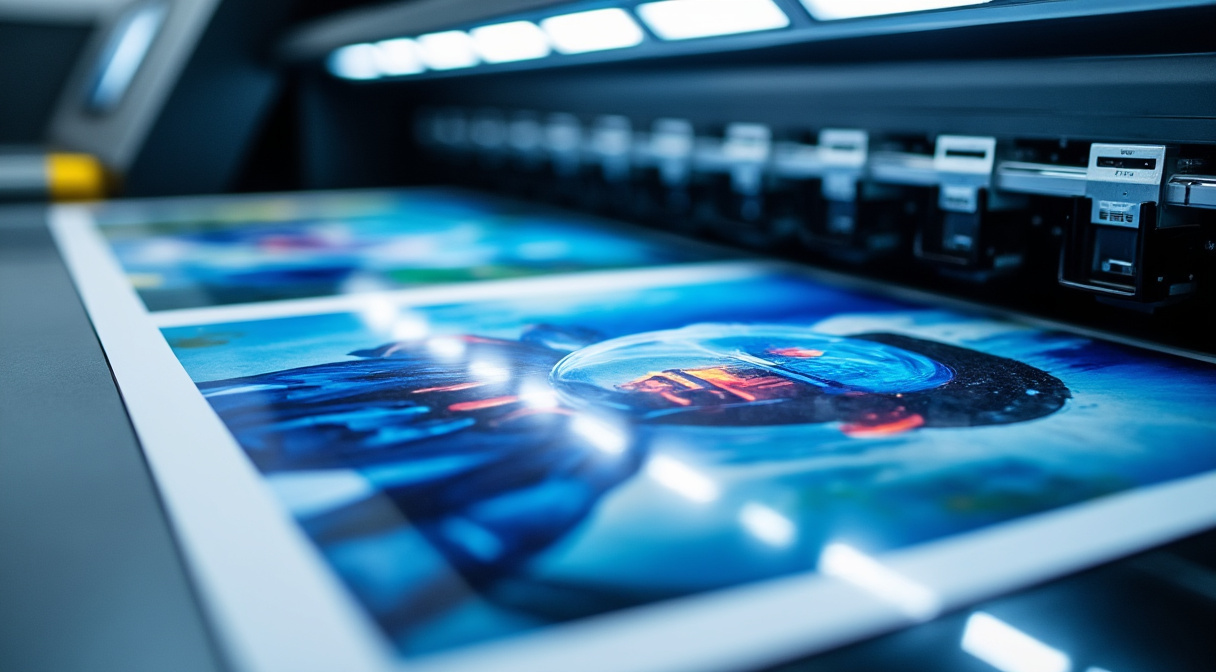
What Digital Printing Is
Digital printing is a method of producing printed materials directly from a digital file, without the intermediate step of creating a physical printing plate. Unlike offset lithography, which transfers ink from a plate to a rubber blanket and then to the substrate, digital printing applies colorants directly to the surface in a single pass through the press. This direct-to-substrate approach eliminates plate costs and makeready time, making short production runs economically viable in a way that traditional processes are not.
The two dominant technologies in commercial digital printing are electrophotographic printing (commonly called toner-based or laser printing) and inkjet printing. Each uses fundamentally different physics to place colorant on a substrate, and each carries distinct trade-offs in speed, quality, substrate compatibility, and cost structure.
Toner-Based (Electrophotographic) Printing
Electrophotographic printing builds images using static electricity. A laser or LED array discharges selected areas of a photosensitive drum, creating an invisible electrostatic image. Dry or liquid toner particles, which carry an opposite electrical charge, are attracted to those discharged areas. The toner is then transferred to the substrate and fused permanently by heat and pressure.
Key characteristics of toner-based digital printing include:
- Sharp text and line work. Because toner particles fuse as a solid layer, fine text and crisp edges are rendered with high precision, making this technology well suited for business documents, direct mail, and transactional printing.
- Consistent color across a run. Electrophotographic presses maintain tight color consistency from sheet one to sheet ten thousand, which is critical for brand-sensitive applications.
- Limited substrate range. Fusing requires heat, which restricts the range of materials that can be used. Very thick stocks, specialty synthetics, and heat-sensitive substrates can be problematic.
- Higher cost per page at volume. Toner consumables and drum maintenance costs mean the per-unit economics become less favorable as run lengths increase, compared to offset for long runs.
Inkjet Printing
Inkjet printing propels tiny droplets of liquid ink directly onto the substrate through microscopic nozzles. There are two main mechanisms: thermal inkjet, which heats ink rapidly to form a bubble that ejects a droplet, and piezoelectric inkjet, which uses a piezoelectric crystal to create mechanical pressure. Commercial production inkjet systems almost exclusively use piezoelectric technology because it supports a wider range of ink chemistries and offers greater longevity.
Inkjet printing has distinct strengths and constraints:
- Very high throughput at competitive cost. Wide-format and continuous-feed inkjet presses can run at speeds measured in hundreds of feet per minute, making them cost-effective for high-volume transactional, publishing, and direct-mail applications.
- Broad substrate compatibility. Because there is no heat-fusing step, inkjet can print on a wide range of papers, coated stocks, textiles, ceramics, corrugated board, and rigid panels, depending on the ink type and press design.
- Ink absorption and dot gain. On uncoated or absorbent stocks, ink can spread as it is absorbed, which softens fine detail. Inkjet-optimized papers and coatings address this but add cost.
- Drying and curing requirements. Aqueous inks must dry; UV-curable inks must be cured with ultraviolet lamps. Both add complexity to the press configuration and affect substrate choice.
Variable Data Printing and Short Runs
One of the most commercially significant capabilities of digital printing is variable data printing (VDP). Because every page is rendered from a digital file immediately before printing, the content of each printed piece can differ without slowing the press or incurring additional setup costs. A single press run can produce thousands of pieces where the name, address, offer, image, or any other element changes from one copy to the next.
VDP is used extensively in direct mail, personalized marketing collateral, transactional statements, and pharmaceutical packaging inserts where regulatory text must vary by market or dosage. The technology relies on composition engines that merge a design template with a database of recipient or product records at print time.
Short-run economics are equally central to the value of digital printing. Offset lithography becomes cost-efficient only above a threshold that varies by press configuration but is often cited in the range of 500 to 1,000 copies, because plate production, ink wash-up, and makeready are fixed costs spread across the run. Digital printing carries no such fixed costs per job, so a run of 50 or 250 pieces is produced at nearly the same per-unit cost as a run of 500. This makes digital printing the standard choice for proofing, on-demand fulfillment, regional versioning, and any application where inventory obsolescence is a concern.
Further reference: https://en.wikipedia.org/wiki/Digital_printing · https://sites.google.com/emeryeps.com/vslprint-commercialprintingnyc/printing-nyc/digital-printing