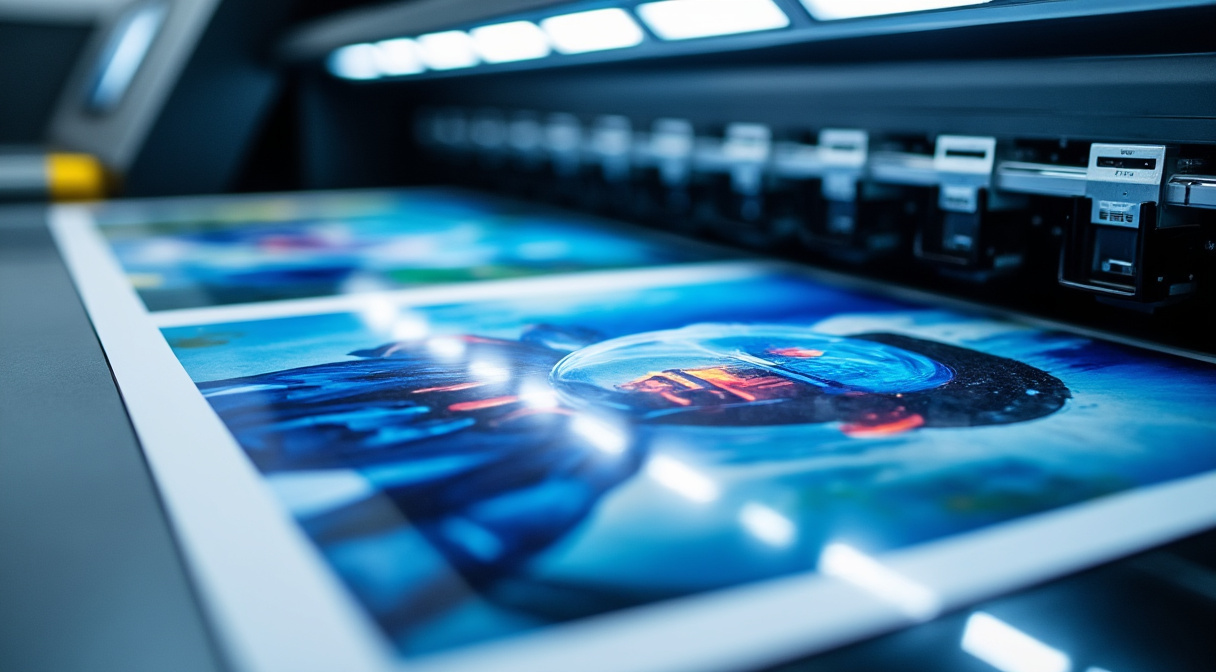
How Digital Printing Works
Digital printing transfers artwork directly from a digital file to the substrate without the intermediate steps required by conventional offset or flexographic processes. There are no printing plates, no makeready procedures, and no minimum run thresholds imposed by setup costs. The press reads color data pixel by pixel and deposits colorant in precise locations, reproducing halftones, gradients, and fine text in a single pass.
Two distinct imaging technologies dominate commercial digital production: electrophotographic (toner-based) and inkjet. Each has different strengths in terms of substrate compatibility, color gamut, resolution, and economical run lengths, so most trade printers maintain both types of equipment to match jobs appropriately.
Toner-Based (Electrophotographic) Printing
Electrophotographic presses, commonly called dry-toner or liquid-toner digital presses, work by electrostatically charging a drum or belt, exposing it to laser light to form a latent image, attracting toner particles to that image, and then fusing the toner to the substrate with heat and pressure. The process is the same fundamental mechanism used in office laser printers, but engineered to commercial tolerances for consistency across long runs and a wide range of coated and uncoated stocks.
Dry-toner presses are well suited to paper weights from lightweight text stock through heavy cover board. Liquid-electrophotographic (LEP) systems use a hydrocarbon-carrier ink rather than dry powder, which allows thinner ink layers and a wider gamut on coated stocks. Both variants deliver sharp, consistent dot reproduction at native resolutions typically between 600 and 2,400 dpi.
Key characteristics of toner-based digital printing include:
- Fast substrate changeover with no plate swaps or wash-up cycles
- Consistent color from sheet one, making short runs economically practical
- Strong performance on standard coated and uncoated offset stocks
- Fused toner layer that sits on the surface, which can affect tactile feel and some finishing operations
- Run lengths typically most cost-competitive below a few thousand impressions
Inkjet Printing
Commercial inkjet presses propel droplets of water-based, UV-curable, or solvent ink through microscopic nozzles directly onto the substrate. Drop size, droplet velocity, and nozzle density determine achievable resolution and throughput. High-speed production inkjet systems use fixed piezoelectric print heads spanning the full web width, which allows continuous printing at speeds that can exceed several hundred feet per minute.
Inkjet technology accepts a broader substrate range than most toner systems. Coated and uncoated papers, synthetic substrates, corrugated board, textiles, and rigid materials such as acrylic and aluminum can all be printed with appropriate ink formulations and surface treatments. UV-curable inkjet presses are particularly common in wide-format applications, label printing, and packaging because the ink cross-links on any non-absorbent surface without requiring heat fusion.
Notable characteristics of inkjet printing include:
- Exceptional substrate versatility, including heat-sensitive and dimensionally unstable materials
- Wide color gamut, especially with extended ink sets that add orange, green, or violet channels
- High-speed web configurations suited to transactional print, direct mail, and book publishing at volume
- Ink absorption into uncoated stocks can soften halftone edges unless specialty inkjet-optimized papers are used
- UV systems produce durable, scratch-resistant output without the need for aqueous coatings
Short Runs and Variable Data Printing
The elimination of platemaking gives digital printing its defining economic advantage for short-run work. Offset printing spreads a fixed prepress cost across every impression, so per-unit cost falls as quantity rises. Digital printing has a near-flat cost curve per impression, making single copies and small quantities financially feasible for the first time. This has enabled on-demand publishing, just-in-time inventory reduction for branded collateral, and affordable prototyping of packaging and labels before committing to longer offset runs.
Variable data printing (VDP) extends the short-run advantage by allowing every single printed piece in a run to carry unique content — different names, addresses, images, offers, or barcodes — without slowing the press or changing any hardware. A VDP workflow merges a design template with a structured data file at the raster image processor (RIP) stage, producing individualized output at full press speed. Applications include personalized direct mail campaigns, transactional documents, event tickets with sequential numbering, pharmaceutical packaging with batch-specific codes, and loyalty program mailers with recipient-specific offers.
Effective variable data production requires close coordination between the data source, the document template, and the RIP software. Common VDP-aware composition formats include PDF/VT and PPML, both of which support object caching so repeated elements such as logos and backgrounds are processed once rather than re-rasterized for every record, preserving throughput even at high personalization density.
Further reference: https://en.wikipedia.org/wiki/Digital_printing · https://sites.google.com/emeryeps.com/vslprint-commercialprintingnyc/printing-nyc/digital-printing